MAY 2025
29 MAY 2025
AFFECTION ARCHIVES No. 88: Natalie Tischler
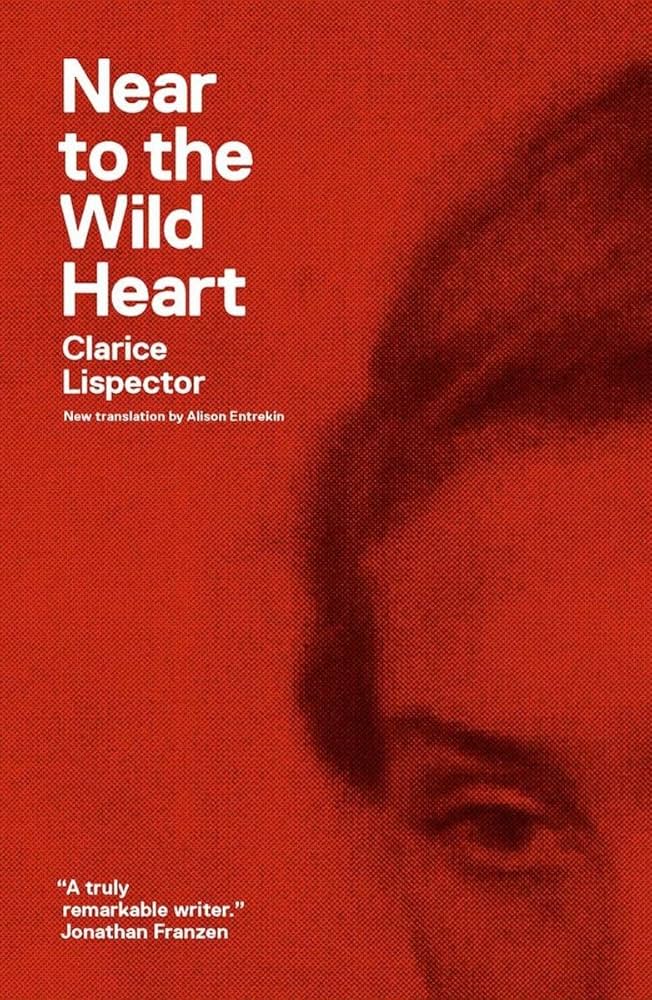
Clarice Lispector's Água Viva, confronting the ordinary, the practice of paying attention, the grid, and latex.
Natalie Tischler is a model and spatial designer, born in Woodstock and now based in New York City. Her work – and life – is grounded in the ordinary moments, textures, patterns, and images of her everyday. She’s always questioning how we see, think, and move through the world, often through language, observation, and design. A few years ago, Natalie began keeping a monthly digital archive of her thoughts, images, and ideas: “Archiving is documentation over time,” she told me. “And documentation is about paying attention.” From Natalie –
- a [language]
I read my first Clarice Lispector book last year, Água Viva, and it came at a time when words and language felt more essential than ever. I was writing every day (I still do, but I was more religious about it then), and language became the way I understand and make sense of my self and the world around me. Language, of course, is a primary means of understanding, but I’m talking about a particular and personal language, a language I found in my self and in Clarice’s writing.
Specifically, the extent and limits of language: how language can be both a means of understanding our experience and a substitute for experience, how understanding our experience through language estranges us from experience itself. Clarice, unlike any author I’ve encountered, somehow both exacerbates and diminishes this tension between words and action, between understanding and experience, between mind and body. When I read Clarice’s work, I feel there are limits to neither language nor experience.
"And when I think a word is strange that's where it achieves the meaning. And when I think life is strange that's where life begins.”
Clarice Lispector, Água Viva
- a [confrontation]
There is a certain way we look, see, listen, and think every day. We each have a way of organizing reality, of seeing and thinking about the world around us. And our attention is directed towards the extraordinary: the spectacular, the tragic … what happens when we confront the ordinary?
“To question the habitual. But that’s just it, we’re habituated to it. We don’t question it, it doesn’t question us, it doesn’t seem to pose a problem, we live it without thinking, as if it carried within it neither question nor answers, as if it weren’t the bearer of any information. This is not longer even conditioning, it’s anaesthesia. We sleep through our lives in a dreamless sleep. But where is our life? Where is our body? Where is our space?...
What we need to question is bricks, concrete, glass, our table manners, our utensils, our tools, the way we spend our time, our rhythms. To question that which seems to have ceased forever to astonish us. We live, true, we breathe, true; we walk, we open doors, we go down staircases, we sit at a table in order to eat, we lie down on a bed in order to sleep. How? Why? Where? When? Why? Describe your street. Describe another street. Compare. Make an inventory of your pockets, of your bag.”
This excerpt is from George Perec’s 1973 essay “Approaches to What?”, one of many works in which he takes inventory of everyday life. I love the way Perec writes about things – literal things – the everyday, the ordinary, the seemingly insignificant things. Objects and spaces and knowledge we encounter every day and don’t stop to think twice about. He brings awareness and experience to the everyday, forces us to encounter and confront the ordinary, and this is a worldview I really appreciate.
There is a lot of meaning to be found in the meaningless, in the nothing, in the overlooked – in confronting the ordinary. Observing and questioning the actions and objects that constitute the everyday, however simple; why is the shape of a chair as such, and how does it relate to the body? Why are a handshake and a hug the postures we assume upon meeting someone? There’s always something not so ordinary when you look at any thing long enough. Each moment becomes an encounter, and the simplest things become novel.
- a [practice]
Confronting the ordinary, to me, is the practice of paying attention – of noticing things, as they are. Of noticing a thing being what it is.
Walking in New York brings me a lot of inspiration. There are a lot of things to pay attention to:
- a [geometry]
Paying attention over time creates patterns. One particular pattern I’ve always payed attention to is a grid. I like the spatial logic of grids, how they define a two-dimensional surface and give structure to a three-dimensional form. I studied architecture and it shaped how I view the world: spatially. There is something very satisfying about grids to me.
"When I first made a grid, I happened to be thinking of the innocence of trees, and then this grid came into my mind, and I thought it represented innocence, and I still do, and so I painted it and then I was satisfied. I thought, this is my vision."
Agnes Martin
- a [material]
Latex is very mysterious. It holds a lot of contradictions: flexibility and tension, strength and decay, opacity and translucence, tactility and discomfort. I’ve become very interested in latex as a material and, by extension, the work of Eva Hesse.
I started to work with natural latex as a shade for a lamp I designed. I really enjoy working with latex – its texture, smell (sweet, I’ve come to find out), how it looks and acts when stretched, how it interacts with light. Also, the contrast between its softness and harder materials; in the case of my lamps, metal and fish hooks.
︎